

Our world is full of unbelievable phenomena that shake our understanding. These incredible sights are both natural and human-made. They go beyond what we think is possible.
This journey takes us to nature’s most puzzling creations and humanity’s greatest feats. Each find shows us the amazing things beyond our daily lives.
Get ready to see wonders that challenge our view of reality. These must-see wonders are truly beyond belief. They’re for those who dare to see them.
Nature’s Most Astonishing Displays
Our planet is home to some of the most amazing natural wonders. They challenge our understanding of physics and biology. These incredible sights are some of Earth’s most stunning atmospheric phenomena and dramatic geological events.
Volcanic Lightning Storms at Mount Sakurajima
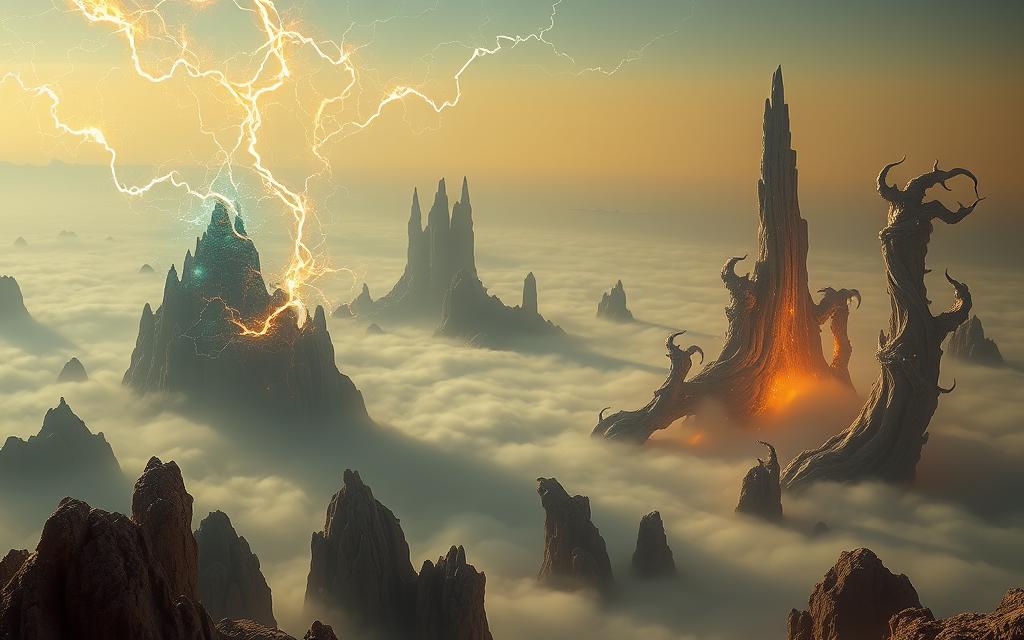
Japan’s Mount Sakurajima is known for its awe-inspiring beauty. During eruptions, lightning lights up the sky. This happens when ash particles collide, creating static electricity.
Scientists say the heat and turmoil in volcanic plumes are perfect for these storms. This mix of fire and electricity lights up the night sky.
Bioluminescent Bay in Puerto Rico
Mosquito Bay in Vieques, Puerto Rico, is magical at night. The water glows blue when disturbed, thanks to dinoflagellates.
These tiny creatures light up when they sense movement. Kayaking through the bay creates shimmering trails, like swimming through stars.

Mammatus Cloud Formations Over Nebraska
The American Midwest often sees these unique clouds. They look like pouches hanging under thunderstorm anvils. Their shape shows turbulent air.
Clouds can weigh a million tonnes, so these clouds show great power. They form when cold air sinks under warmer air.
Even though they’re linked to severe weather, mammatus clouds don’t cause damage. They are truly striking to see.
Architectural Marvels That Defy Logic
Humanity’s skill in structural engineering has led to amazing buildings. These creations push the limits of physics and design. They show the best of human ingenuity, turning impossible ideas into real wonders.
The Burj Khalifa’s Record-Breaking Engineering
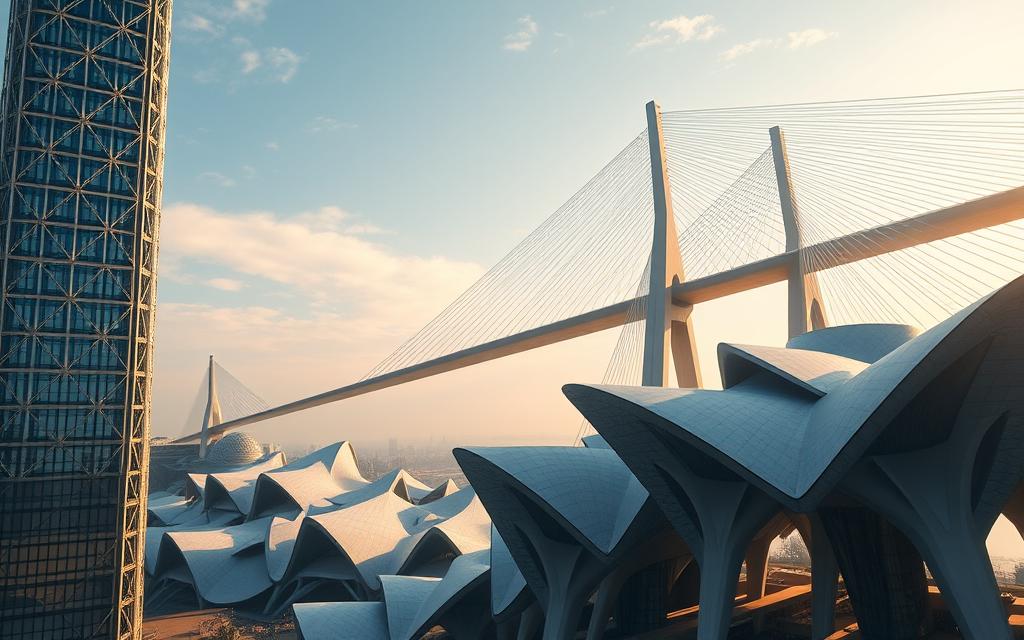
The Burj Khalifa in Dubai is a marvel of modern engineering. It reaches 828 metres high, needing new solutions to handle strong winds and heat.
The tower’s Y-shape cuts down wind pressure. Its strong concrete structure keeps it stable. A special concrete mix was made to handle Dubai’s hot weather during building.
China’s Zhangjiajie Glass Bridge Suspension System
The Zhangjiajie Glass Bridge in China is a bold mix of engineering and tourism. It stretches 430 metres over a canyon, with a walkway 300 metres up. It offers both excitement and stunning views.
This bridge uses a complex system of steel cables and glass. It’s designed to last through harsh weather. Amazingly, it can hold up to 800 people at once, despite looking very thin.
India’s Living Root Bridges in Meghalaya
In Meghalaya’s rainforests, people use living rubber fig trees to make bridges. This is a unique example of sustainable design. It shows how human ingenuity can work with nature.
Locals use betel nut trunks to guide tree roots over rivers. These bridges get stronger as they grow. Some are over 500 years old and can carry dozens of people.
This method is a remarkable example of bio-engineering. It’s where nature and human skill come together. The bridges get better with age.
Human Achievements Pushing Physical Limits
Our planet moves 2.5 million kilometres daily around the sun. Yet, some people choose to go even further. They push their limits to the extreme, showing what humans can do with determination and tech.
Alex Honnold’s El Capitan Free Solo
Alex Honnold’s free solo climb of El Capitan is a top extreme sports achievement. He climbed nearly 900 metres of granite in Yosemite without ropes or safety gear.
This incredible feat needed top physical shape and mental focus. Every step had to be perfect for over three hours. One wrong move could have been fatal.
James Cameron’s Mariana Trench Descent
Deep-sea exploration hit new lows with James Cameron’s dive to the Mariana Trench. He reached the deepest point on Earth, nearly 11 kilometres down.
Cameron used a special submersible to survive the extreme pressure. He spent hours alone, doing science in one of the toughest places on Earth.
International Space Station Assembly Missions
The International Space Station is a huge off-world project. It took over a decade and many flights from different countries to build.
Astronauts did risky spacewalks to link modules in orbit. They worked in zero gravity at 28,000 kilometres per hour. The station shows what we can do together with tech.
These amazing achievements show humans can do anything with courage, hard work, and the right tech.
Animal Kingdom’s Most Bizarre Behaviours
Nature’s creatures show us amazing things that make us question what’s possible. These animal adaptations are incredible examples of evolution. They help us understand how different species survive.
Mantis Shrimp’s 16 Colour Receptors
The mantis shrimp has the most advanced vision in the animal world. Humans see in three colours, but this sea creature sees in sixteen.
It can see colours we can’t, like ultraviolet and polarised light. Its eyes work on their own, giving it amazing depth perception.
Octopus Instant Camouflage Techniques
Octopuses are experts at hiding. They don’t have tentacles but have eight arms that can change shape.
Their skin has special cells that change colour instantly. This lets them blend in with their surroundings in seconds.
Bird of Paradise Elaborate Mating Dances
In New Guinea’s rainforests, male birds of paradise show off in incredible ways. They use their feathers, voices, and dance to impress.
Females watch many males before choosing one. This competition makes their displays even more stunning.
These amazing behaviours show nature’s endless creativity. Each adaptation is a unique solution to survival. They’re perfect for wildlife documentary fans and scientists studying unique senses.
Optical Illusions That Completely Deceive Perception
Our brains try to make sense of what we see, but sometimes they fail. These visual tricks show us how our senses can be tricked. They use clever arrangements of space, light, and perspective.
Ames Room Forced Perspective Illusions
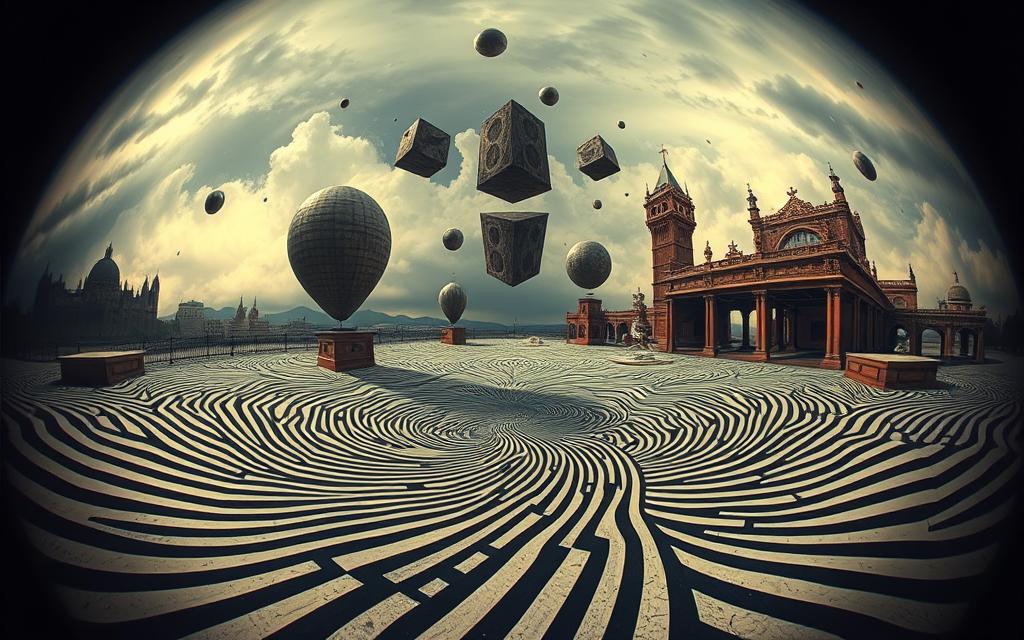
The Ames Room is a great example of visual tricks through forced perspective. It has a trapezoidal shape and angled walls. This makes objects appear to be of impossible sizes.
When two people stand in opposite corners, one looks huge and the other tiny. Our brain expects rooms to be rectangular, leading to wrong depth perception.
Julian Beever’s 3D Pavement Art
Julian Beever is a master of anamorphic art. He turns flat surfaces into amazing three-dimensional scenes. His chalk drawings on pavements create depth illusions that only work from one view.
This art form needs a lot of math and understanding of perspective. Beever’s work includes scenes that look like bottomless pits and swimming pools. They exist only through clever visual tricks.
Fata Morgana Mirage Phenomenon
The Fata Morgana is nature’s most complex mirage. It shows advanced perception psychology principles. This mirage happens when temperature gradients bend light, creating distorted images of distant objects.
These mirages can make ships seem to float in the sky or turn landscapes into dreamlike castles. The name comes from Morgan le Fay of Arthurian legend. It reflects the mirage’s magical, deceptive quality.
Each illusion shows different sides of perception psychology. They range from architectural tricks to artistic mastery and atmospheric conditions. They show how our visual system can be tricked by understanding light, perspective, and how our brain processes information.
Extreme Weather Events Captured in Detail
Nature’s most violent expressions create spectacular visual displays. Modern technology lets us document these events with great clarity. This gives us both scientific insights and amazing footage.
Oklahoma Tornado Alley Time-Lapses
Oklahoma’s Tornado Alley is known for its dramatic supercell thunderstorms. Storm chasing teams capture mesmerising time-lapse footage of these systems’ life cycles.
The footage shows how rotating updrafts turn into organised mesocyclones. These systems can spawn multiple tornadoes during their development.
Advanced forecasting helps researchers place cameras perfectly. They capture everything from wall clouds to violent tornado touchdowns.
Catatumbo Lightning Venezuela Records
Venezuela’s Lake Maracaibo has the world’s most concentrated lightning activity. The Catatumbo lightning phenomenon creates an average of 28 strikes per minute during peak activity.
This natural light show happens up to 300 nights a year. The unique topography and wind patterns create perfect storm conditions.
Meteorological records show over 1.2 million lightning strikes yearly. The constant electrical activity makes it a vital scientific study site.
Lightning’s danger is highlighted by surprising statistics. Giraffes are 30 times more likely to get struck than humans due to their height and isolation on savannahs.
Australian Bushfire Fire Whirl Documentation
Australia’s bushfires sometimes generate terrifying fire whirls – spinning vortices of flame and superheated air. These phenomena combine the destructive power of wildfires with tornado-like rotation.
Documented cases show fire whirls reaching temperatures over 1,000°C. They can lift burning debris high into the atmosphere, spreading fires unpredictably.
Recent footage captures these vortices forming during catastrophic fire events. The visual documentation helps researchers understand their formation mechanics and improve firefighting strategies.
These extreme weather events show nature’s raw power at its most spectacular. The detailed documentation provides both scientific value and awe-inspiring visual records.
Underwater Wonders That Challenge Marine Science
The ocean’s depths hold mysteries that amaze scientists and explorers. These underwater marvels are among the most incredible discoveries in ocean exploration. They challenge our understanding of our planet’s aquatic worlds.

Great Blue Hole Geological Mysteries
The Great Blue Hole off Belize’s coast is a stunning geological formation. It’s 300 metres wide and 125 metres deep, forming a perfect circle seen from space.
Studies have found layers of stalactites at 40-55 metres below sea level. These show past climate conditions, formed during ice ages when sea levels were lower.
The hole’s chemistry creates layers of water with different oxygen levels. This supports various marine life at different depths. It gives scientists valuable insights into life in extreme underwater environments.
Hydrothermal Vent Life Forms Discovery
In 1977, hydrothermal vents were discovered, changing marine biology forever. These underwater geysers spew hot, mineral-rich water from the Earth’s crust. They create life oases in the dark ocean depths.
Vent communities use chemosynthesis, not photosynthesis. Bacteria convert chemicals into energy, supporting life. Giant tube worms, blind shrimp, and unique molluscs thrive here.
These findings are key to understanding life on other planets. The vents’ extreme conditions are similar to those found on distant worlds. This expands our search for life beyond Earth.
“The discovery of life at hydrothermal vents changed our fundamental understanding of where and how life can exist on Earth.”
Cenote Angelita Underwater River Mexico
Cenote Angelita in Mexico is a stunning sight in ocean exploration. It has an underwater river that looks like it’s flowing. This is an illusion created by nature’s chemistry.
The “river” is actually hydrogen sulphide gas between fresh and salt water. It looks like a river with underwater trees and branches. These have fallen into the cenote over centuries.
Divers going through the hydrogen sulphide layer feel disoriented. The gas makes it impossible to see before clearing into the saltwater. It’s a unique diving experience.
This natural wonder shows how complex water interactions can create impossible landscapes. It’s a focus for researchers studying underwater geological formations and their ecological impacts.
Cultural Practices That Defy Western Understanding
Across our diverse planet, countless communities maintain ancient practices that appear extraordinary through Western eyes. These remarkable world traditions often stem from deep spiritual beliefs and cultural heritage that have endured for centuries.
While some customs might seem unusual to outsiders, they hold profound meaning for participants. Understanding these practices requires appreciating different cultural perspectives and historical contexts.
Japan’s Naked Festival Rituals
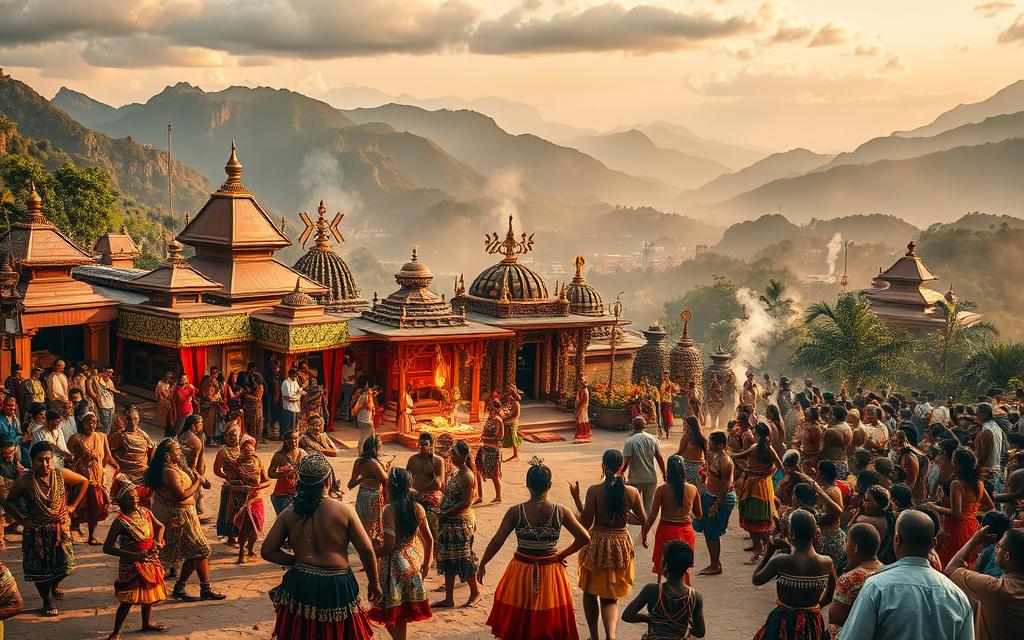
Each February, the Hadaka Matsuri transforms Japanese temples into spectacular displays of devotion. Thousands of men wearing only loincloths brave freezing temperatures to participate in this intense religious festival.
The climax occurs when priests throw sacred sticks into the crowd. Participants believe catching these objects brings good fortune for the coming year. This physical endurance test demonstrates spiritual commitment that transcends comfort.
India’s Kavadi Attam Ceremonial Piercings
During Thaipusam celebrations, Hindu devotees undertake extraordinary acts of sacrifice. The Kavadi Attam involves piercing skin, cheeks, or tongues with sharp metal objects as offerings to Lord Murugan.
Participants enter trance-like states through meditation and chanting. They carry elaborate structures called kavadis while processing to temples. This practice represents gratitude for blessings received or requests for divine assistance.
Spain’s El Colacho Baby Jumping Tradition
In the village of Castrillo de Murcia, an unusual tradition occurs each Corpus Christi. Men dressed as devils leap over babies laid on mattresses in the streets. This practice dates back to the 17th century and continues today.
Locals believe the jumps cleanse infants of original sin and protect them from evil spirits. The Catholic Church has expressed concerns, but the community maintains this unique cultural ritual as part of their heritage.
| Tradition | Country | Purpose | Participant Numbers |
|---|---|---|---|
| Hadaka Matsuri | Japan | Spiritual purification | 9,000+ annually |
| Kavadi Attam | India | Divine offering | Thousands nationwide |
| El Colacho | Spain | Protection ritual | Local community event |
These extraordinary cultural rituals demonstrate humanity’s diverse approaches to spirituality and community bonding. They remind us that meaningful practices can take many forms across different societies.
While Western perspectives might initially find these traditions surprising, they represent deep cultural values that deserve respect and understanding. The endurance of these practices through centuries shows their importance to participating communities.
The Absolute Craziest Shit Ever Documented
Some moments are so extraordinary, they become legends in digital folklore. These events are the most unbelievable, captured by modern technology. They are preserved for all to see.

Chelyabinsk Meteorite Impact Footage 2013
On 15 February 2013, Chelyabinsk, Russia saw a dramatic event. A meteor entered Earth’s atmosphere at 67,000 km/h, creating a fireball brighter than the sun.
The airburst was as powerful as 400-500 kilotons of TNT. It shattered windows and injured over 1,500 people. The event is remarkable because of the many videos captured.
Dashcams, security cameras, and phones recorded this cosmic event. These videos give scientists valuable data and show one of the most spectacular recorded moments in history.
Danny MacAskill’s Urban Cycling Stunts
Scottish trials cyclist Danny MacAskill has changed how we see urban cycling. His 2009 video “Inspired Bicycles” showed incredible balance and bike control in Edinburgh.
MacAskill’s videos feature:
- Precise bunny hops between building ledges
- Backflips over concrete barriers
- Mind-bending balance on narrow rails
- Gap jumps across urban structures
These viral videos show human potential at its limits. They turn cities into playgrounds. Each stunt took countless hours of practice and dedication.
Leopard Enters Indian Apartment Building
In 2021, a leopard entered an apartment building in Gurugram, India. This unexpected event caused panic among residents.
Wildlife officials took six hours to safely sedate and remove the leopard. This incident shows the growing conflict between humans and wildlife in cities. It also captured a dramatic wildlife encounter on camera.
Security footage shows the leopard calmly moving through the building. This contrasts wild nature with urban development. It’s a remarkable visual record and a cautionary tale.
These three examples show the power of modern recording technology. They capture cosmic events, human achievements, and wildlife encounters. They allow us to share moments that were once unbelievable stories.
Conclusion
This journey has shown us the amazing world we live in. We’ve seen everything from volcanic lightning to incredible engineering. These things show us how reality can be even stranger than fiction.
Looking back, we see how our understanding of the world has grown. What once seemed true, like Earth being at the centre of the solar system, now seems odd. This is similar to how some cultural practices seem strange to others.
The world is full of wonders, both in nature and in human cultures. Keeping our curiosity alive lets us see the incredible variety around us. There’s always more to learn about our complex planet.
We should keep discovering and exploring what makes our world so interesting. The most amazing things are often just beyond what we know. They invite us to look closer at the world around us.